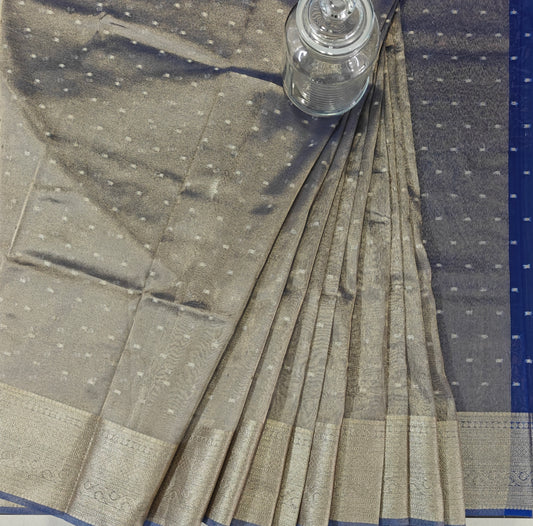
How to Identify an Original Banarasi Saree
Banarasi sarees are globally celebrated for their exquisite zari work, intricate motifs, and timeless charm. However, with numerous replicas in the market, distinguishing an original Banarasi saree from an imitation can be challenging.
This beginner-friendly guide from Silken Saga explains how to identify a real Banarasi saree using simple visual, tactile, and structural checks—so you can invest confidently in authentic Banarasi craftsmanship and heritage.
Quick Checklist: How to Identify an Original Banarasi Saree
- Woven (not printed) motifs visible on the reverse side
- Soft, natural zari shine—not harsh or plasticky
- Integrated border and pallu (not pasted or stitched separately)
- Balanced weight with a rich yet fluid drape
- Consistent weaving across the body, border, and pallu
1. Look for Signature Banarasi Motifs
Authentic Banarasi sarees feature motifs inspired by Mughal and traditional Indian art. Common Banarasi patterns include kalga (paisley), bel (creeper), jhallar borders, traditional paisleys, and intricate meenakari floral vines.
These motifs are woven into the fabric—not surface printed—and appear rich and detailed on both sides of the saree.
2. Check the Reverse Side (Weave vs Print)
Turn the saree over and examine the back carefully:
- Original Banarasi saree: Visible floating threads and woven texture on the reverse side (tana–bana structure).
- Fake or imitation: Flat surface with no thread movement—often printed or machine-pressed.
3. Evaluate the Zari Quality
Real Banarasi sarees use zari woven into the fabric. High-quality zari has:
- A soft, elegant metallic glow (not overly shiny)
- Uniform weaving without patchy or broken areas
- No flaking or colour rubbing
4. Inspect the Border and Pallu
In an original Banarasi saree, the border and pallu are woven as part of the fabric itself.
- Look for jhallar borders that feel integrated, not attached
- The pallu should display dense, continuous brocade work
- The transition between body and pallu should feel seamless
5. Feel the Fabric
- Original Banarasi silk feels soft, smooth, and cool to touch
- It has weight, but never feels stiff or rubbery
- The drape is fluid and graceful, not rigid
6. Look for Craftsmanship Indicators
Whether handloom or powerloom, authentic Banarasi sarees show:
- Precise motif alignment
- Consistent zari tension
- Clean selvedges and pattern continuity
Traditional handloom Banarasi sarees often have 6–8 inches of loose threads at the end of the weaving area—commonly called the “koniya.” This is a natural result of hand weaving and a sign of authenticity.
7. Fabric-Wise Identification Tips
- Katan Silk: Crisp structure, sharp motifs, heavier feel (view collection)
- Dola Silk: Softer drape, lighter weight, subtle shine (view collection)
- Mashru Silk: Silk surface with cotton comfort underneath (view collection)
8. Compare the Price (Reality Check)
Authentic Banarasi sarees involve skilled labour, quality silk, and time-intensive weaving.
- Powerloom Banarasi sarees: typically ₹2500–₹5000
- Pure Katan silk or heavy brocade Banarasi sarees: ₹6000+
If a saree looks extremely ornate but is priced unusually low, it is most likely printed or synthetic.
9. Common Myths About Banarasi Sarees
-
Myth: Only handloom Banarasi sarees are real
Reality: Powerloom Banarasi sarees are also authentic when woven correctly -
Myth: Heavier means better quality
Reality: Quality depends on weave and zari, not weight alone
10. Buy from Verified Sellers
Always buy from sellers who clearly mention fabric type, weave method, and provide close-up images.
At Silken Saga, we curate only authentic powerloom Banarasi sarees—soft to wear, rich in look, and fairly priced—so Banarasi elegance remains accessible without compromising craftsmanship.
Explore More Banarasi Guides
• Types of Banarasi Sarees
• Banarasi Blouse Designs
• History of Banarasi Sarees
Frequently Asked Questions (FAQs)
How can I quickly tell if a Banarasi saree is original?
Is a powerloom Banarasi saree still considered original?
What price range indicates a fake Banarasi saree?
What are typical motifs found in original Banarasi sarees?
How do I check if the zari is real?
Shop Banarasi Silk Sarees collection
-
Kashi Georgette - Pink and Blue Contrast Saree
Regular price Rs. 2,499.00Regular priceUnit price perRs. 5,500.00Sale price Rs. 2,499.00Sale -
Blue Tissue Silk - Banarasi Saree
Regular price Rs. 3,000.00Regular priceUnit price perRs. 5,000.00Sale price Rs. 3,000.00Sale -
Gehra Neela Ghat Print - Banarasi Saree
Regular price Rs. 3,000.00Regular priceUnit price perRs. 5,000.00Sale price Rs. 3,000.00Sale -
Haldi Peela Ghat Print - Banarasi Saree
Regular price Rs. 3,000.00Regular priceUnit price perRs. 5,000.00Sale price Rs. 3,000.00Sale